Live demonstrations at Booth 4-642 (Hall 4) will showcase real-time AI vision pipelines
optimized for embedded hardware accelerators and built on the open-source AI ecosystem.
Nuremberg, Germany, March 6, 2026 – Savoir-faire Linux, a leading open-source software engineering and consulting firm specializing in embedded and industrial systems, announces at Embedded World 2026 the official launch of its Edge AI engineering services. Building on more than 25 years of expertise in embedded Linux and open-source technologies, the company now offers a dedicated consulting and development practice focused on deploying artificial intelligence directly on embedded devices.
Today, the rapid acceleration of AI innovation is largely driven by the open-source ecosystem, from deep learning frameworks and model architectures to hardware acceleration units. For companies developing embedded systems, leveraging this ecosystem effectively requires deep expertise in both AI software stacks and embedded hardware platforms. Savoir-faire Linux brings this dual capability, helping industrial organizations translate open-source AI innovation into reliable production-ready systems.
Edge AI as a Strategic Industrial Capability
For many industries, including robotics, manufacturing, transportation, and smart infrastructure, Edge AI is rapidly becoming a critical capability.
“Artificial intelligence is moving rapidly from centralized cloud environments to embedded systems operating directly in the field,” says Jérôme Oufella, Technology Vice-President at Savoir-faire Linux. “Much of this innovation is happening in open-source ecosystems. At Savoir-faire Linux, open source is the foundation of our engineering culture, and our expertise lies in turning these technologies into robust embedded AI solutions optimized for real-world industrial constraints.”
To illustrate the capabilities of this new offering, Savoir-faire Linux will present two live demonstrations at its booth (Hall 4 – Booth 4-642), highlighting how advanced AI workloads can run efficiently on resource-constrained embedded platforms. These demonstrations showcase the engineering challenges and hardware-software optimizations required to achieve deterministic real-time performance at the edge.
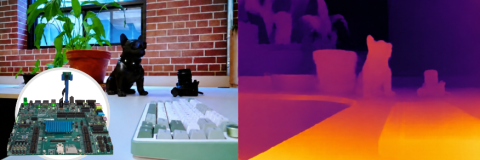
Demo 1 – Real-Time Monocular Depth Estimation on Toradex i.MX95
The first demonstration showcases real-time monocular depth estimation running at 30 frames per second on the Toradex Verdin i.MX95 platform.
Using a single RGB camera, the system generates a depth map of the scene in real time by leveraging the Neutron Neural Processing Unit (NPU) integrated in NXP’s i.MX95. This approach removes the need for expensive sensors such as LiDAR or stereo camera rigs, reducing both system complexity and hardware cost.
Running entirely at the edge, the system enables advanced perception capabilities for applications including autonomous mobile robot navigation, forklift driver assistance, conveyor-based dimensional inspection or obstructions and collision detection.
Achieving this performance required extensive model optimization targeting the NPU architecture. Savoir-faire Linux engineers adapted the depth estimation model to avoid CPU fallback paths and redesigned post-processing pipelines to maintain stable inference at 30 FPS.
“Deploying AI on resource-constrained systems is not only about running a neural network,” says Dr. Thomas Garbay, Edge AI Expert at Savoir-faire Linux. “It requires deep optimization across the entire software stack, from model architecture and hardware compilation to real-time post-processing. This demo shows how careful co-design between hardware and software enables reliable spatial AI directly on embedded platforms.”
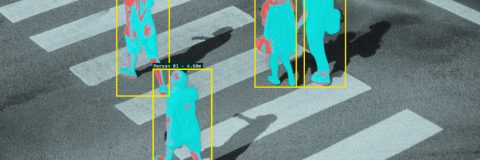
Demo 2 – Real-Time Instance Segmentation on Renesas V2H
The second demonstration presents instance segmentation running on the Renesas V2H platform using a YOLO neural network optimized for embedded hardware.
Instance segmentation provides pixel-level boundaries for each object in a scene, enabling accurate identification, localization, and counting, even when objects overlap.
Such capabilities are increasingly required in industrial environments for applications such as automated production-line inspection, bin-picking robotics, logistics automation or personal protective equipment (PPE) compliance monitoring.
To enable real-time performance on a constrained embedded platform, Savoir-faire Linux’s engineers leveraged the Renesas DRP-AI hardware accelerator and applied aggressive pruning techniques that reduced the neural network backbone by 70–90%, while maintaining model accuracy.
Additional optimization of segmentation mask post-processing significantly reduced inference latency, demonstrating how advanced computer vision workloads can run reliably on embedded platforms without relying on cloud infrastructure.
A New Engineering Practice for Edge AI
The launch of Savoir-faire Linux’s Edge AI services addresses a growing demand from industrial manufacturers seeking to integrate artificial intelligence directly into connected devices and embedded systems. The company’s new offering covers the full Edge AI lifecycle, including:
- Model optimization and hardware acceleration (quantization, pruning, NPU compilation)
- Computer vision and sensor-driven AI pipelines
- MLOps for large fleets of embedded devices
- Hardware-software co-design for embedded AI systems
- Training AI models to specific data and domains
- Engineering consulting and team enablement.
By combining deep embedded systems expertise with AI model optimization, Savoir-faire Linux enables organizations to deploy high-performance, low-latency AI solutions directly on devices, ensuring reliability, sovereignty, and reduced dependency on cloud infrastructures.
Meet Us at Embedded World 2026
Savoir-faire Linux invites Embedded World attendees, journalists, and industry analysts to visit its booth (Hall 4 – Booth 4-642) to experience the demonstrations live and discuss Edge AI deployment strategies with our engineering team.
Dr. Thomas Garbay, Edge AI Expert, and Jérôme Oufella, Technology Vice-President, will be available throughout the event to present the demos and exchange with visitors about the technical challenges of deploying AI in embedded environments.
Helpful links
About Savoir-faire Linux
Founded in 1999, Savoir-faire Linux is a leader in open source software engineering, offering consulting services, training, and custom development for embedded and industrial systems. With offices in Montreal (Quebec) and Rennes (France), the company empowers clients worldwide across industries ranging from energy and transportation to telecommunications, robotics, and consumer products. As an active contributor to The Linux Foundation ecosystem and projects as the Yocto Project, the Zephyr Project or the LF Energy, Savoir-faire Linux promotes collaborative innovation and delivers high-performance, secure, and sustainable embedded solutions.