
Blog and News
Image of an arrow

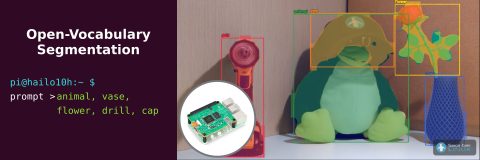
Prompt Anything: Instance Segmentation with YOLOE-26 within a Hailo-10H Running YOLOE-26 as a “prompt anything” segmentation within a edge NPU, from model surgery and INT8 quantization to a 15.6 FPS (640px) / ~31 FPS (320px) fully optimized live pipeline. YOLOE-26’s open-vocabulary support lets operators type any class name for real-time segmentation on the Hailo-10H. Our […]

Avatar
19 Aug. 2026 Reading from 9 minutes.

What’s new? We’re happy to announce the release of v2.9.0, which includes a few new features as well as bug fixes. Check out the summarized changelog below: Updated npm dependencies, addressing various security warnings Ported license completion to the generic language server (neovim) Added a Walkthrough for getting started with the extension Minor bugfixes Adopted […]

Vulnerability assessment: VulnScout or Dependency-Track? Complex software systems may include hundreds or even thousands of vulnerabilities. In such contexts, it is crucial to be aware, monitor, and assess vulnerabilities detected in products. In Europe, the Cyber Resilience Act (https://digital-strategy.ec.europa.eu/en/policies/cyber-resilience-act) makes it mandatory for products with digital elements. Similar requirements also exist in other regions and […]

Monocular Depth Estimation on the Verdin i.MX95 for Edge AI   Deploying Monocular Depth Estimation on the Verdin i.MX95 for Edge AI: model adaptation, INT8 quantization, and a full embedded software stack for real-time depth inference at 30 FPS from a single RGB camera. Monocular depth estimation involves reconstructing a depth map from a single […]

Prompt Anything: Instance Segmentation with YOLOE-26 within a Hailo-10H Running YOLOE-26 as a “prompt anything” segmentation within a edge NPU, from model surgery and INT8 quantization to a 15.6 FPS (640px) / ~31 FPS (320px) fully optimized live pipeline. YOLOE-26’s open-vocabulary support lets operators type any class name for real-time segmentation on the Hailo-10H. Our […]

Monocular Depth Estimation on the Verdin i.MX95 for Edge AI   Deploying Monocular Depth Estimation on the Verdin i.MX95 for Edge AI: model adaptation, INT8 quantization, and a full embedded software stack for real-time depth inference at 30 FPS from a single RGB camera. Monocular depth estimation involves reconstructing a depth map from a single […]

Live demonstrations at Booth 4-642 (Hall 4) will showcase real-time AI vision pipelines optimized for embedded hardware accelerators and built on the open-source AI ecosystem.   Nuremberg, Germany, March 6, 2026 – Savoir-faire Linux, a leading open-source software engineering and consulting firm specializing in embedded and industrial systems, announces at Embedded World 2026 the official launch […]

Optimizing YOLO Training for Real-Time Detection on a LiDAR system This is the second of a three-part series on real-time YOLO detection on a LiDAR system for Edge AI. Find Article 1 on generating synthetic depth and NIR datasets here. Currently, new low-resolution embedded LiDAR such as the VL53L9CX, are emerging as a highly suitable […]

Enable Real-time Detection with Synthetic LiDAR Data Generation This series of articles will cover the essential components required to build real-time detection on a system with a dToF 3D LiDAR module. This first article is focused on synthetic LiDAR data generation. Synthetic LiDAR data generation for real-time detection Real-time Detection on a LiDAR System: Training […]

What’s new? We’re happy to announce the release of v2.9.0, which includes a few new features as well as bug fixes. Check out the summarized changelog below: Updated npm dependencies, addressing various security warnings Ported license completion to the generic language server (neovim) Added a Walkthrough for getting started with the extension Minor bugfixes Adopted […]

Vulnerability assessment: VulnScout or Dependency-Track? Complex software systems may include hundreds or even thousands of vulnerabilities. In such contexts, it is crucial to be aware, monitor, and assess vulnerabilities detected in products. In Europe, the Cyber Resilience Act (https://digital-strategy.ec.europa.eu/en/policies/cyber-resilience-act) makes it mandatory for products with digital elements. Similar requirements also exist in other regions and […]

Introduction In the embedded world, the question is no longer which OS should I use, but how can I make them work together? Modern SoCs are blurring the line between real-time microcontrollers and application processors. Chips like the STM32MP2 from STMicroelectronics integrate both a Cortex-A35, capable of running a full Linux distribution, and a Cortex-M33, […]

Accelerating early Linux boot with Yocto multiconfig By Paul Le Guen de Kerneizon Introduction In embedded products, cutting seconds, or even hundreds of milliseconds, from power‑on to application readiness is often critical. In this article, I will present a practical workflow to measure, compare, and iteratively reduce the early boot window of a Linux embedded […]

In today’s world, where everything from coffee machines to industrial equipment is connected to the network, knowing and assessing the security of your software and its dependencies has never been more important. Most vulnerabilities originate from small bugs in software components, and more recently (and thankfully less frequently) from sophisticated supply chain attacks. But with […]

Author : Luc Beaufils, Embedded Systems Engineer   Debugging MCUs has always been the key to producing high-quality code, but reliance on vendor-specific IDEs and complex debug server configurations can hinder a smooth development workflow. While VSCode has revolutionized the way developers write and debug code, setting up a debug session for MCUs can sometimes […]

  Empowering the Embedded Industry to Tackle the EU Cyber Resilience Act and Cyber regulations with an Innovative & Open Source Vulnerability Management Tool.   Nuremberg, March 11, 2025 – Savoir-faire Linux, a leading open-source software engineering and consulting firm, is proud to announce the official release of VulnScout.io, an open source cybersecurity solution designed […]

Savoir-faire Linux is excited to announce DHTNet, a powerful new C++17 library spun off from the Jami project that simplifies peer-to-peer connectivity. DHTNet enables developers to establish secure P2P connections between devices using only public keys, eliminating the need for centralized infrastructure or direct IP addressing. Features Connection Management: DHTNet simplifies the establishment and management […]

2024 was particularly rewarding for Savoir-faire Linux. We had the opportunity to take part in key events accross the Energy and Embedded sectors. We have built new partnerships and strenghtened our position in Open Source communities. We also had the pleasure to sponsor two events this year, the LF Energy Summit and Montréal Python. In […]

Keeping up with our 2023 retrospectives, we wished to highlight the contributions we made throughout the year to the various open-source projects we use on a daily basis for our needs and those of our customers, or those in which we are strategically involved in their development or maintenance. As a member of the Yocto […]

Hello ! My name is Emma Falkiewitz and I am 21 years old. I am in my 4ᵉ year of computer science school at Compiègne University of Technology (the UTC) in France. I just finished my internship at Savoir-faire Linux where I worked on Jami. How did this career choice come about? In high school, […]

2023 was a very prolific year for Savoir-faire Linux. To mark the announcement of our sponsorship of the LF Energy Summit 2024, we were keen to share a retrospective of the conferences we took part of in 2023. With captivating projects thanks to our R&D investments and our customers, we were able to present our […]

Our personal and professional lives are often punctuated by encounters with men and women who have left their mark and inspired us, whether through their skills, their social or political commitment, their vision or their leadership. We have this tradition at Savoir-faire Linux of paying tribute to some of these remarkable personalities and highlighting their […]

Because the UX is not limited to the connected world, if you go to Miami one day and you have to take the train, look no further: opt for the Brightline. This rail network has been able to include UX and the customer experience in its process and it makes the train ride extremely pleasant. […]

Tout le monde UX, abbreviated TLM UX, is the meeting UX (User Expericence – User Experience) of the Montreal scene. Offering conferences on the subject every 2 months, TLM UX organizes meetings between enthusiasts, professionals or just curious people about the field of User Experience. Having as partners the big names of Montreal agencies like […]

From July 28th to August 5th, one of our team members, Hugo Lefeuvre (also a Debian Developer on his free time), attended DebConf18, the annual Debian Developer’s Conference, in Hsinchu, Taiwan. During this week, Hugo spent time preparing and giving a talk about Ring, hacking on Debian packages, discussing free software communication and distributed networks with fellow developers and users. […]

        Savoir-faire Linux and ICTC celebrate the first cohorts of the successful graduates from the Small Business Digitization Initiative (SBDI). The first students, the pioneers, started last January their six-month journey which can position them as the next generation of digitization talents. They went through an intense in-class training helping them understand how […]